
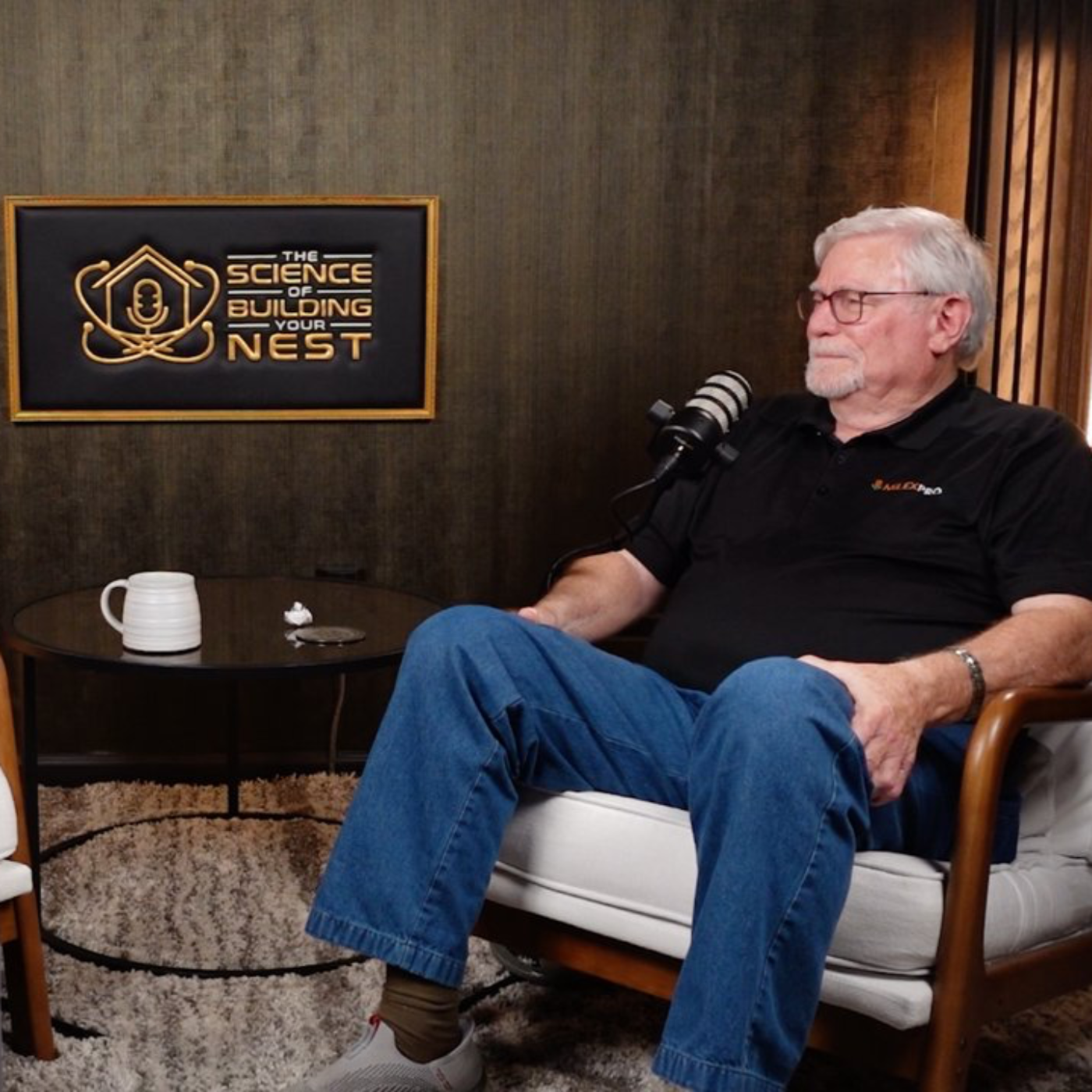
Episode 7 / Jun 20, 2025 / 70 min
Disrupting Industries with Milo Insulation and Sorghum-Based Solutions
with Tom Martin
Where to find Tom Martin
Founder, Milo Insulation
Show notes
Tom Martin, founder of Milo Insulation, joins the podcast to share how a humble grain - sorghum - is driving a new wave of sustainability in the building industry and beyond. This drought-resistant, carbon-efficient crop is being used to challenge the status quo - not just in insulation, but across multiple industries that rely on petroleum-based materials.
We discuss the origins of the Milo brand, how Thermal Puff technology gives sorghum its edge, and why plant-based products like this are more than just eco-friendly - they’re high-performing, cost-effective, and built for the future. If you're curious about building science, sustainable materials, or what it really takes to innovate in a legacy industry, this episode is packed with practical insight and big-picture thinking.
Key moments
- How a sorghum cookie sparked an idea
- Cracking the sorghum extrusion puzzle
- Landing the first big packaging customer
- Discovering a natural plastic
- Why sorghum makes a better attic insulation
- Clearing out old attic insulation
- Sorghum, the drought tough crop
- Franchising Milo across the country
- Honest labels and what biodegradable means
The mailing list
Get the next conversation in your inbox.
One short email when a new episode drops, plus practical tips on healthy homes and building things that last. No spam.
Transcript
Well, my name is Keating. Uh, this is the science of building your nest podcast. Um, we're here to talk about entrepreneurial ship and building science. I am extremely happy to have, uh, Tom Martin on, and he is the, um, founder of Milo insulation. And Milo insulation, at least from my standpoint, checks the building science box, as well as the insulation box. So Tom, welcome. And I'm excited to hear the wonderful stories that you have to offer. All right. That's great. Interestingly enough, back in 1992, doing some experimenting, I was in exporting the foodstuffs to Europe. And a gentleman walked into my office wanting me to try a sorghum made cookie. And
this cookie, Keating, tasted something like wet cardboard. No taste at all. It was terrible. But he was a nice old man. I appreciated his scientific knowledge. So I took that cookie and I stuck it down in my desk drawer. And over a year went by. and uh bringing me more cookies everyone's trying to bring me a different flavored cookie that all tastes like steel cardboard a year later i was in amarillo texas they're talking about high plains desert and a year later i moved my offices cleaned out my desk drawer for the first time bottom of my dress door there were four or five cookies and i took them out and they were just like the day i put them in there
That's interesting a wheat cookie in West Texas over a year would be dust in my drawer This has an interesting characteristic and I was exporting snack food stuffs to Europe and I'm thinking Our processing in our country is cheaper than theirs But the shelf life going over made it so they had to process what I shipped them over there If I could pre process it here, it'd be an advantage to both of us and I start thinking about that A little while later, I was traveling on an airplane out in California, going to a farm, and bored, picked up the magazine in the compartment ahead of me on the seat, and I started reading an article about Napa Valley wine growers using real popcorn to package fine wines in shipment because of the polystyrene backlash. Light bulb.
That cookie tastes terrible, but it still had that cushioning, protective feeling. This is not a snack food cookie. This is a packing material Once in a while you get an idea that you why didn't I think of that? In fact, why didn't somebody else think of that? So I started exploring that first thing I did I knew that Texas A &M University I was in Texas is a sorghum expert. So I went to see them about Extruding or expanding sorghum to make a packing material I'm sorry A &M boys, but I did not get a good feeling from Texas A &M. The main feeling I got from them was we know if we didn't think of it, it probably doesn't work. At that time, I just happened to be on
the governor's committee in Kansas for value added products. So I ended up going to Kansas State University. where I found out later they have the premier extrusion lab in the country for exploring extrusion techniques. They're the ones that discovered how to make a fast food restaurant chicken that really doesn't have any chicken in it at all. It's just it's chicken flavor with a bunch of cornstarch. That's right. And I took a couple of seminars from them learning how to do that, by the way. So I went up there and said, help me take this sorghum and turn it into a packaging material. And we're talking about two professors that are expert in extrusion, but never sorghum. Sorghum is a very different animal than corn, wheat, rice, or soy. And after
a week's worth of experimentation, they were scratching their heads because everything that made corn amulose starch expand made sorghum pectin shrink. Absolute opposites. They were puzzled and I was elated because it means this is something special. What I need maybe is a different kind of extrusion. That same cookie manufacturer fellow had introduced me to a company in Dallas, Texas called Maddox Metalworks. Maddox Metalworks makes baked type extrusion. That's the machine that makes snack foods like Cheetos. Take cornstarch and expand it. maybe their machine would be better because that's a different kind of extruder than what the lab was using. So I went to see the manufacturer at Maddox and I've
had an excellent relationship with them for the last 30 years because he loaned me a $125,000 extruder I put in the back of my pickup, drove back to Manhattan, Kansas, installed it in the lab and those two scientists and I learned how to expand sorghum that had never been done before. Then we discovered that certain varieties of sorghum expanded well and others did not. By trial and error then, we started expanding varieties that worked and making packing material. In about 1992, I was ready to try the packing material idea and we moved from Colby, Kansas to Scottsdale, Arizona where I put in a plant, an extrusion
plant to make packing material. I know nothing about industrial packing material, but it looks like a good idea. And all you saw was really the idea in Napa of these people who sold wine using popcorn as a package. It came from that. It came from that because who wants to use real popcorn? I mean, real popcorn is oily. It attracts bugs. I mean, it didn't sound like a good idea to me, but in fact, people don't like polystyrene peanuts. They're afraid to throw them away. And I discovered that garages are full of it for that reason. And what was the packaging material of the day? What did most manufacturers use? Polystyrene peanuts. In the early days, I'm thinking early days in the 90s when I started playing with it, there were half a dozen people trying
to make natural packaging out of corn starch. And all of them was calling it biodegradable, which it was not. I went to a trade show in Anaheim, California in about 93, 94, and there was a corner in the trade show, packaging trade show, of half a dozen of us that had biodegradable packaging. Everybody had to sign biodegradable packaging. And it kind of upset me because I knew they were using a lot of polymers in there that would not be biodegradable. It would be water soluble. There's a difference between biodegradable and water soluble. So at the noon of the first day, I told one of my salesmen, go find a grocery store. Buy us a big bowl and a couple of jars of salsa. And that afternoon we were eating our
packaging materials. And the next day the other signs were gone. All of a sudden now they're putting up signs that say natural packaging material and not biodegradable packaging material. Difference in technology there. So we started doing that in Arizona and I had some really good luck as an entrepreneur. because I went to Arizona my wife and I with a machine on the back of a gooseneck trailer behind a pickup and we installed it in a building and we started making packing material we were going to try to how do we try this and I noticed that right down the street from me at Priest and University in Scottsdale Arizona was a company called Micro Age Computers and at that time they were a major supplier of computer parts all over the all over the country the world
really and I saw trucks going in and out of there all the time. So I just went down there and I walked in and I said, I want to see your shipping manager. So I went to see the shipping manager and I said, I would like you to work with me to explore the idea of a biodegradable packaging material. And he lit up like a light bulb heating. I am under so much pressure to do something about our polystyrene. So I took him a hundred bags, 10 cubic foot bags of loose fill packing material made out of sorghum and said, here, try this. At that time, neither he nor I were sophisticated enough to work out a protocol on how they tested it. And I'd given him a bunch of little pieces of flyers that said, this is a natural biodegradable
packing that can be successfully thrown away in a landfill. And he said, throw it in every box. So he took it to his packing people here, try this and throw these in the boxes. They sent the entire hundred bags to one customer. And it just turned out that that customer was JCPenney in Arlington, Texas, their largest distributor. Somebody at JCPenney in Arlington, Texas got that sign, took it to his boss, and the next thing I know, Micro Age Computers in Scottsdale, Arizona gets a fax saying, don't send us anything else, just that. We didn't know. And my grades didn't know that Penny's was paying a big price to a special landfill in Dallas because the Dallas landfill would not take polystyrene peanuts.
Well, I couldn't make it that fast. They were shipping 100 containers a week. And I had started off in Scottsdale with a machine on the back of a trailer because I thought I would move it around because I knew I couldn't ship the product. And after a couple of weeks, I got some farmer friends that were partners to come out and help me get it off the trailer so I can get my truck back. And we never looked back. Well, it's amazing. It's amazing that the environmentally friendly aspect of this product, it wasn't necessarily the fact that it was similar enough to the polystyrene product, but the fact that it was biodegradable now saves extra costs that these manufacturers or these companies were having to spend just
to get rid of the product. That's right. Everybody at that point and still today are looking for ways to package without using plastics. I'm talking about petrochemical definitely petrochemical plastics are a problem in our landfills and always have been probably always will be and I was offering a solution to that that was practical and then we kind of learned as we went along that not only was this a natural packing material it was a better packaging material because it's stronger We could take, I used to use a test when I would sell the packaging material, take a cubic foot box, fill it clear to the top with polystyrene. Take another one just like it, fill it clear to the top with the product we call Mylex, made out of sorghum. And then go to the customer and
set a Coke can on top and take the box and tap it with my finger like this. With polystyrene peanuts, the Coke can just sinks like a sinking ship. It goes right to the bottom. which is what happens to your widget when you're shipping. On our stuff, being stronger and more resistant, it just set up there and bounce around and, wow, protect the package better so it's a better package material and... biodegradable. And a better insulator because it is rigid and it's well we learned about the insulation from our customers and over the years uh 10 years of making packing material we put in 16 uh extrusion plants around the United States to make packing material and we start getting feedback from customers about two things
they no longer had any damage in their shipping from from temperature change nor did they have any damage from their shipping in electric problems because if you ship something with a battery in it and polystyrene it'll kill the battery. It'll drain the battery. I had a customer in Phoenix for example that was a major supplier of bear couplers. Their big customer was the U.S. Forest Service in Alaska where they put a collar on a bear that had a tracking device so if somebody poached that bear they would catch them and they were having a 40 percent failure rate in their in their system, because when they ship it from Phoenix by air to Anchorage, almost half of them no longer work. Right, they're out
of battery or their tracking device didn't work. And they told me they had one of their tracking devices that made it up there, and somebody shot the bear, took the collar off, beat it on a rock, threw it in a lake, and they still caught him. But it wasn't electric, they caught him, you know, it was strong. And wow, that impressed me too. and then i started getting uh comments from customers like you know we ship this and there's no transfer of heat so it's highly insulated so after 10 years or so of making packing material our biggest competitor at the time was sealed air corporation out of new jersey and uh their their head guy walked in my office and Irving unannounced and said man i'm so tired of competing
with you guys what would it take to buy the rights to this and we'll make it so they bought the rights to the packing material in 2011 and then we thought yeah we made packing material and that worked we have a natural plastic what's the next product It's crazy. I love the entrepreneurial zeal that you had from seeing the cookie and going into these different avenues, trying to find the benefits of a sorghum product and then what happens when you start to do these different things with it. But you didn't stop there. What gave you that? That next level to want to push onward right because you kind of completed your American dream per se right of starting this company and we had discovered a natural plastic
And the natural plastic and let me use that definition. So our listeners know what we're talking about here Technically a plastic is anything that can be formed or molded Shakespeare referred to a plastic as mud or frown because you can make a frown and if you held it that's a plastic frown for example. We've come to think of petrochemical plastics like we think of Kleenex as facial material. Nobody says hand me a facial tissue. They say hand me a Kleenex. Marketing. A plastic is anything that can be formed or molded. And this product under extrusion can be formed or molded into about any shape you want. So it's a natural plastic. So what else can we do with a natural plastic?
Well, packing material is about a 200 million dollar market but loose insulation and attics is a six eight to ten billion dollar market and growing very fast certainly so we look at insulation but already on the drawing board i have a number of other things i think we can make i can solve some of the problems with this technology my next step if somebody comes along and takes a step up with the insulation sooner or later somebody will I wanted to make a size about like Rice Krispies. I take those Rice Krispies and I tumble them in a dried herbicide and then I broadcast it on a field at planting. And I would hold active agent of herbicide in the kill zone of the weeds.
Because we got a big problem in our farms all over the world with putting on herbicides that leach down into the water, get into the groundwater, get into our drinking water, get into the stream, kill the fish or whatever. It's a problem. The reason it's a problem is because when it rains, herbicides leach down into the soil and the kill zone of a weed is about the upper quarter of an inch. Right. The plants aren't sucking up all of those chemicals. If I could hold that. If I could hold that active agent in that upper kill zone, one, we could use less active agent. Two, we wouldn't have the runoff of the problem. That's an even. bigger thing maybe than the insulation, but that's another step forward. Did you have any idea the ripple effect of what this product could become when you had figured out the extrusion
process? We keep finding new ones. Absolutely. And it stems from the problems of what we've created just through our normal manufacturing process already. My theory of politics basically. is that all our environmental problems in the world will be solved through such things as finding a niche. And I consider this finding a niche. Government will not be the solution. Entrepreneurship will be the solution because there's a niche. If I can make a profit doing something that solves an environmental problem, that's what I'm gonna do. Yeah, but it takes finding the niche and making it available to the masses through the
properties of what you found right at a practical application it has to be practical because no one would switch over to a sorghum packing peanut if it was 10 times more expensive right there has to be a practical application for your number one it needs to be a better product that's true then if it's environmentally correct oh my that's nice and if it's affordable that's even more nice right right so that's how we got into installation to make a circle and come back to that The insulation that we make in Milo insulation is a superior attic insulation to anything else on the market and more practical. Over the long term, it's the cheapest way to insulate an attic because it doesn't shrink over a period of time. U.S. government says that 5.3 % of all U.S. households
insulate annually. Well, I guarantee you my customers don't insulate... annually to five percent, nowhere near it. We rarely, rarely get in a house today that doesn't need insulation. Because with existing ways to insulate in homes today, after 10 years, you don't have the same, after 15 years, you don't have anything. And we can have houses that haven't been insulated since the 1960s. There's nothing up there but dust. And they don't realize what they're losing in the efficiency of that house. So we can come in, take everything out of the house, seal it so that nothing gets back into the environment in the house, because that's a big point too, clean air. And then put a product in that doesn't shrink over time, and you got a very efficient way to do it. And oh, by the
way, it checks all the environmental boxes. It's natural. It's non-allergenic. It's pretty. It doesn't itch. It blows easily. It's affordable. And those are the key factors to being successful. Yeah and then besides the the um you know sorghum product itself there's borax that goes on it as well for bug resistance and fire resistance. We toss it in borax uh natural borax is like soap 20 mil team borax if you will and nothing likes borax uh it's not offensive to humans but bugs don't like it mice don't like it you know roaches don't like it and it's a fire retardant. Well, in talking from the perspective of being in a lot of attics with either fiberglass insulation
and having to dig through to find a duct that might be broken or the other kinds of insulation, I mean, there's plenty of things that happen to your skin, but also the dust that comes from those products you're breathing in when you go up in the attic. And then, like you said, if your attic isn't sealed or the drywall is not sealed from the insulation, a lot of those fine particulates are getting into I'm curious if someday somebody doesn't discover that installers that install fiberglass insulation on a daily basis have the same problem as asbestos people in the past. Totally. They're breathing small pieces of Recycle glass is basically what they're doing and at least for manufacturer specifications of the installation manual wear your wear your
mask when you're installing those products and things like that, but You know, that's really I feel good that in our product. We don't have to have any protective clothing We don't have to have the only time our people use masses if they're cleaning out the other stuff I don't like them sucking out fiberglass or related mineral wool or something without a mask because it's stirring up a lot of dust particles and so forth. And we might use a mask and it's itchy and all that kind of stuff that we don't like. we don't make we don't make any points by running down the competition that there's a lot of of insulation out there that that is a good insulation fiberglass and cellulose will insulate for a while i don't have any problem with that i mean it's the initially the cheapest way to insulate a house is probably
fiberglass if you want to do it you know, regularly because it will lose its effectiveness. Uh, foam is an excellent insulator. I don't want to have anything to do with foam myself because I think it's dangerous. If you talk about putting a yellow, a yellow ribbon around your house when you're doing it and you're wearing a hazmat suit, I think. I don't want to do that. Somebody else can do that. It's a science experiment done on site. That's exactly right. And then the long-term for spray foam as well, closed cell and open cell. I mean, there's different people that I've listened to that have talked about the degradation of the R value of the spray foam. And so now you have an attic that's built with your roof deck insulation, but now you may need to add insulation on top of your drywall after the fact. Just recently, we've been running into customers
here in the Austin area that call us and want us to take the spray foam out of their attic. because they're having trouble selling their house. Either because the buyer doesn't like it, or more likely because the home inspector won't approve the house because he can't see the roof. Not a big problem. In our West Texas, Tulia area about a week ago, we were asked to remove foam out of an attic, but it was open cell. And what we discovered is removing open cell was easy. So we went ahead and did that because it'll chip off and fall down in chunks. Closed cell, it would be a nightmare trying to remove it. So we don't do that. So I worry about them. And the people don't realize if you foam the attic at the top of a house, what you're doing is creating an envelope where you better heat and cool the attic too. So now you need
more air conditioning and a little bigger unit because you're sealing the house, maybe more than you should. And a lot of what I'm saying there comes from a guy named Jim Dutton. When I first started in Denton, Texas, one of the first calls I had was from Jim Dutton. He said, I have a letter here from a listener and he wants to know about Mylex, this product. Can I come see it? I said, it just happens that we're doing a house in Sherman this afternoon. You're welcome to come up. And I expected him to drop by. I didn't expect him to show up with four people and a film crew. and he filmed us doing the Attic and Sherman and today if you go on Texas Home
Improvements website and Quarry Insulation you'll still see the same video on there that was made back when we started that and he became a big supporter of us and I appreciate his attitude about that. Well and talk a little bit about why um, you know, why you would want to pull out insulation in an attic, because I know, at least from my experience, I've seen attics where you start with bats underneath and then probably 10 years later, they added fiberglass and then 10 years later they added cellulose. Yeah. And then frequently you run into a house that's been roofed a couple of times and they shoved the shingles and the nails. That's right. So I should, uh, most people they get up in their attic and look, and it's just plain nasty. Maybe it has mouse droppings, maybe it has shingles and nails, like you said, two different kinds of insulation.
And you walk around and if there's any light, you can see the particles floating in the air and I want that out. And so we do offer a vacuuming out of the office and more than half of the houses that we insulate. we vacuum it out first. And that's kind of the the top of our offering of what we can do for a homeowner. We suck everything out of the attic and take a foam can and seal around any outlet that goes back down into the house around can lights or around piping or something like that. They're the wires that come up from the top plates. Yep. And so nothing from the air can get back down into the home environment itself. It's important. Or for the condition there that you're cooling in your space doesn't also escape through the attic. Right. And wasted effort. Because a lot of the times when you see a fiberglass bat inside the attic around a penetration,
you'll see dirt spots because there's been a positive pressure inside the environment that's going up and touching the insulation. One of the things I worry about most when we're doing that, I tell my people be very careful of heating fans in bathrooms. A couple of years ago we were doing a house and I was at the house out by Perryton, Texas way out in the rural area of Texas and a farmer had built his own house and insulated it himself with cellulose years before. And then later he decided to put a heater fan in his bathroom. And what he'd done is cut a hole in the ceiling, reach in there and find the wiring going to one of his lights, bring it over and hook it into the fan without removing the insulation or getting up in the attic. So he just pushed it up into
the attic, into the insulation, not realizing that when the heater turned on, it opened a flap into the attic that released the heat. Well, the insulation kept it shut. And when we took the insulation out, I found the joist burned about this far on each side, about six inches on each side, where it had tried to burn. But the fiberglass, or the cellulose rather, had smothered it. And I took a picture and showed the woman. I thought she was going to faint. Be very, very careful with heater fans and an egg. Very dangerous. Totally. It's not hooked up. Properly and most of the time in Texas. We don't see those Maybe we'll see some radiant heating on the floor. But yeah, that's a that's a new one for me Yeah, that that scared me and it certainly scared them. We have to be very careful about Getting into a vent or something
when we're blowing in and make sure when we leave we've I had an example one time we did a house where I didn't notice that there were two heating closets and One of them didn't have a proper ventilation. We didn't even know it we blew over it When I was getting ready to leave, one of the last things we do at home is check all the closets and the vents and everything, make sure we didn't get something in the vent. I opened the door to that back heating closet and it was full of insulation. We had to take that out. We just have to be very careful. Well, and I think, you know, in general, inside of an attic, it is part of the building system. And so when you look at the exhaust fan specifically, making sure that those are vented to the outside with
with normal fiberglass or cellulose insulation, you're going to want bats on the on the roof deck or, you know, towards the eaves of the house. Is it the same with with your insulation product specifically? Yes. Yeah, pretty much. We treat everything the same as everybody else does. We're just doing it more environmentally and we're doing more efficiently. If you put an insulation up there that last indefinitely and I tell my customers hey if the roof blows off and it's raining you're going to replace your insulation because it is biodegradable but you're not polluting the neighborhood and it's kind of the least of your worries if your roof blows off when a storm is raining uh people say what happens if I get a leak well you get a leak in your roof you get a little divot a little hole in the insulation
it won't mold because it's mold resistant so you go up fix the leak first and then take a stick and just smooth over the hole and you're back to fine. The only case where we've had to replace insulation was remember back in, I believe it was 21, we had that really, really cold winter where it got down, it even got down almost zero down here. And we had homes that had water lines in their attic and froze and broke when it thawed out. So we had an area the size of a chair there where they degraded the insulation and we'd sell them up. cubic foot 12 cubic foot bag go out and fill it back in that's rare that's very rare that we have to replace insulation so we give a lifetime warranty that basically says if handled
properly and it doesn't get wet now humidity doesn't bother it houston humidity doesn't bother we did a house in alvin texas that is between galveston and houston to test that a few years ago, right before that hurricane came right over the house. We went back down to make sure that the extreme humidity and wind hadn't affected it. It didn't affect it at all. But if it gets wet, sometimes if we're doing a house and we spill it in West Texas, we get a 60 mile an hour wind. We're doing a house. It'll blow down the block a little bit. Take a garden hose and wet it. it's gone and it's gone and I've had women ask me to put some in their garden because it's very high in nitrogen so if we water it in a garden it fertilizes the plants what an amazing
product In general, right? And we had talked earlier about the different uses of sorghum. Can you talk a little bit about the plant itself? Yeah, sorghum is an interesting plant. It's what was developed by our egg colleges to solve the problem of what to grow on the high plains because we got migratory birds, we got drought situations, we have a high wind. So we have to have something that's short enough so the wind doesn't blow it over. That's a tough enough crop so the birds don't eat it as they pass through. and that will withstand years of drought. I'm from Amarillo. The average rainfall in Amarillo is about 19 inches. But average doesn't mean a thing because it might be 21 years, nothing the next time.
So we had to have a crop that would withstand all that. And sorghum has a very unique characteristic. The unique characteristic is if it gets dry and hot, it just goes dormant. It just hangs in there. It rains and cools down and here it comes again. Any other crop that we try to grow if it gets dry it dies. Sorghum does not do that and sorghum is very simple and cheap for the farmer to grow. The problem that you and I talked about earlier for farmers is that the price of sorghum is the same it was in 1946. So the only way our farms and farmers can survive is to grow more pounds per acre and that's what they've done forever. I was at a conference this is interesting about a year ago with the sorghum. genetics experts
at Lubbock, Texas Tech University. And they had figured out genetically how to make a sorghum bud produce three seeds instead of one. And they were bragging about the fact that they maybe could go from 6,000 pounds to the acre to 16 or 18,000 pounds per acre. And the farmers I was with were very, very excited about that. Wait a minute, guys. You already have a bigger supply than demand, which is keeping it cheap. Now you're talking about three times the supply. You better be doing some marketing. And we talked about that earlier too. Farmers might not be the best marketers. No. American farmers, believe me folks, are the most successful producers in the world and the worst marketers in the world
because they grow a crop and it's not worth anything. So they need a bigger truck. They need more pounds per acre. because that tractor that was $5,000 for their granddaddy is $250,000 for them. And they better do more acres and they better do more pounds per acre to get it done. And that's what the American farmers have done. That's why, to the folks that have listened to this podcast and don't know anything about agriculture, that's why the American farmer is the best producer in the world. Because we don't tariff to protect our farmers, which means the farmer... can only survive by producing more as something that we've already got too much of. So supply has always been the farmer's problem, always. When I was in exporting, I discovered that the best way
to help the farmers and to make money on my part was to go to Europe and see what they wanted to buy. And then come back to the Kansas, Oklahoma, Texas farmers and grow this because we can sell it for more money. And we did. And we made We made good money doing that. So we made things like dry edible beans and sunflower seeds. We grew sunflowers that the seed came from Israel, came to Kansas. We reproduced the seed, packaged the seed, and the best market was Israel and shipped it back to Israel cheaper than they could do it over there. And that was because of our cost of production. Yeah, the amount of land that the United States has, especially on the Great Plains that you were just talking about. If it weren't for tariffs, we'd feed the whole
world. We'd be feeding the whole world. And that's because we haven't protected our farmers with tariffs. Well, and if you can touch on the amount of sorghum needed to insulate, let's say you were the only insulation manufacturer in the United States, what would be the percentage of sorghum grown to cover that? Yeah, the insulation market in the United States is so huge, it would be a long time before we could reach 1 % of it. But if we had 1 % of it, I have 14 farmers growing for me now, five or six of them could do it. Another advantage of it is that it's so easily reproduced and we grow so much of it, we have an oversupply. So there'll never be a problem
with supply of the natural resin that we use to make plastics and we're doing something that is renewable, totally renewable. So we check all the environmental boxes and oh by the way, it's cheap and it works. The best product to solve environmental issues in our philosophy is a product that is better than what's on the market now. and yet checks all the environmental concerns and that's what this product is. The main thing that we're concerned about now is how to take this product that we've perfected and and now been using for years effectively and in thousand homes and make it available in the United States and in the world. The only way to do that is to franchise. So we're going
to franchise and have extrusion plants in major market areas because you can't ship the product as you and I talked about before. The raw material that we make in West Texas is very heavy. The insulation is very light. So the goal is to have multiple manufacturing locations and entrepreneurs starting their own business. that want to have a business that's exciting to get into and makes money, and in on the ground floor. Like I told you, we have five current locations. I'm working on about eight, and according to my consultants, there's room for 400 in the United States, so we've got a ways to go. build a company for yourself and take a product that is not only environmentally friendly, but like you said, it's better than what the existing products are out there to be
able to now facilitate future entrepreneurs through your idea at the beginning. I think it really goes back to the entrepreneurial zeal that you had to find what this product could fit in. That's what our typical franchisee I'm finding the interest coming from young people like you. that are excited about the concept or people that have worked for themselves or work for someone else rather for 30 years and they're tired of work over somebody else so maybe they build enough money to jump out on their own. We have some company plants that we started with where the managers, if you say, yeah, I want to buy this territory. I want to run it myself. And we do that too. So I've got two right now that are thinking about buying out a company location. Well, I think that the
one thing that I think of, you know, and I know building science isn't something that you're necessarily trying to focus on because it is a better product than it is going to last for the lifetime of the home. But from a building science aspect, I mean, we talk about the particles, not only in the attic, but inside the home. I mean, we, we see a lot of customers that have, um, you know, issues with their health because of maybe the building materials or the type of, you know, the system specifically that's in their house. The first home that we did that was a new home was in Amarillo years ago. And it was a couple that were from Houston and they decided to move to Amarillo to have a cheaper, maybe a better environment to retire in. And they were having a house built in Amarillo and they hired a custom. builder and the the buyer specified
in his specs he wanted our insulation because he found us on the internet well at that time we were relatively new and the builder didn't know us so he just ignored it uh because he didn't have any idea where we were even though we were right there and the homeowner came up to see how the house was going and he saw him putting in fiberglass insulation on the wall and said hey i specified natural insulation i want natural and the builder said well i i don't know anything about that he's willing to sell the house to somebody else so so the the builder came to us and said i need you guys uh so we bid the house and it was our first home for new homes that we did years ago and we went into the home and that builder worked us through every possible thing that you could do for the builder ceiling
and meeting specs and everything you could think of and by the time we were done with the house the builder came to me saying could you insulate a couple of my riddle houses and we ended up insulating those for the builder then. So we do custom homes because we're a little more expensive than fiberglass initially. but over a period of time you don't replace it, it's much more efficient. So a custom home builder has something they can offer. the buyers saying, hey, you want to upgrade, like you upgrade your windows or you upgrade your doors, you upgrade your HVAC, or you can upgrade your installation and never have to do it again. And it's a good selling point for custom builders. Yeah. And I think for spec houses too, I mean, we had talked about that earlier of, you know, maybe upgrading the installation in a spec house. Who knows who would
be buying that house? If it's a rental property, in theory, you're, you're able to market to your renters that, hey, you're not going to spend as much on electricity. There's there's so many avenues that insulation affects and I know we had talked about earlier about you working more on the Bat insulation for Milo as well, which I think is fantastic I think we can make a bat and initially we will make a product that would be kind of like Tyvex Only it would be highly insulative put a reflective shield on both sides or on one side of it I think I know how to do that But like you and I talked earlier before we can get into something we have to test it enough to know the number one. It's practical I can make a lot of things that don't make any sense. For example, I made a conduit holder, an injection molded conduit holder that holds
a piece of electrical conduit on the wall. And I injection molded it. I've had it for 15 years and I've carried around in my briefcase. I still got it. It's hard, it's practical, it's natural. We made one because what we discovered is that when you're extruding a product like the sorghum product it goes from an extrusion process it goes from a solid product to a liquid product in about half a second and then expands when it hits the air when it comes out if that process stops we tell our our operators do not try to extrude in a thunderstorm because if the power goes off it welds itself in there like a welder
real quick. And then you got problems getting your tooling apart. Well, we made one and then we spent the rest of the day getting the injection molding machine apart because it wouldn't pull back. Injection molding in our country is a push-shove, push-shove, push-shove, like a cartridge going in. And the initial injection molding after World War II was invented by the Japanese and they used a ratchet. die so a constant flow went to a ratcheting die that would work but that's not what we do here we use that shotgun approach it's just another plastic you talked about we talked about throwing something at the wall can we do that yes but that wasn't practical you know that was interesting i still carry around the conduit holder but i'm not going to make
conduit holders because i'm going to make one at a time or i have to figure out how to do it an injection molding machine Years ago, when I was doing packaging material, I had a couple of things came up that were very interesting. You might find this interesting. I was contacted by a company called Pennsylvania Paper Company. Pennsylvania Paper Company back in the 90s had about 70 percent of McDonald's business for clamshells. They made clamshells. Clamshells out of polystyrene were very efficient in a way to keep the hamburger warm. And the only problem was Kids did not like the fact that it was indestructible of landfill. And kids have caused McDonald's to switch to paper. Now you get a McDonald's hamburger. It's
packaged in paper, but paper does not keep your hamburger warm. It's not as good a packaging as a polystyrene, but it's entirely considered more acceptable. So Pennsylvania papers, can we make a clamshell out of myel? Well, let's see if we can. So we started experimenting with that. And long about the same time, I was contacted by a company called Takara Suzo. Takara Suzo is a Japanese company that is the largest manufacturer in the world of sake. And they also own Kentucky Bourbon. And Japan, anybody that has traveled in Japan knows they have a terrible problem with landfill because Japan has no landfill. Japan takes their garbage, loads it on barges. goes out into the ocean until the current goes the
other way and pushes it off the barge. That's why the Southern Pacific Ocean has places full of plastic that you can see from space. It's an island of plastic, mostly from Japan, because they have no way to get rid of that. And so a big part of that was millions and millions of sushi bowls. bowls for sushi and they said if you could make that and they made me a very lucrative offer so we started figuring out how we could do that and then I thought well if we could do that why couldn't we make a tray to put meat and fruit on in a supermarket that you could take it and throw it to the garbage when you take the meat off because I know how to make that waterproof on one side with a natural product.
So we thought about that some of the investors that I had in the company that made the packing material Also as an investment built stores for a company called Dylan supermarkets, which was very popular in Kansas Shortly after they had built some of those stores Dylan's was bought out by Kroger Kroger actually kept the administration of Dillon's in Hutchison, Kansas to run Kroger. So here the headquarters of Kroger at that time was in Hutchison, Kansas. I don't know if it still is or not. But I got introduced to the head honcho at Kroger. So I went to Hutchison, Kansas to talk about a tray for meat marks. Could you help me explore it? Test it. And I went in
and I told him I could make a biodegradable transfer. He's got to come out of his chair. Oh my God. He said, tell you what, any store you want in Kansas, I'll let you use it to experiment with. We'll contribute what money because we would like to solve that problem. He said, there's two things you got to consider. He said, what's that? He said, well, number one, we use 13 truckloads a week of polystyrene trays in our system. We can't take one store out. It's all or nothing. I start thinking about how many hundreds of extruders I'd have to make that many trays. Impossible. The other problem is, he said, if you notice a tray in a supermarket has a little lip around the edges of that tray, next time you take one,
feel there's a little special shape of the lip. Trademarked. You can't make a tray with that lip on it. What's the lip for? It holds it on the line. As it fills it was down the line you put something on it was out there and holds it on that conveyor belt The other problem is polystyrene trays are 100 % The same weight Meaning you only need one scale because you know what the tray weighs you put something on it you weigh it and you can stamp it But a natural product is not that consistent you get a little bit of variation two scales So a whole different kind of packaging would have to be invented. So I back up and say,
okay, the only way to make something like that is a smaller market that I could fill. So we have to be careful what market we go for. If we can't fill the market, it would be a big mistake to try. Then you would need a specific process for this product, too. That's right. So I'm thinking, what if I could make a tray that would bring your medicine on in a hospital, where because of cross-contamination, they have to be sure they only use it once? Right. They bring you a little tray, about two inches by four inches. And here's your pills and then the trash and it's polystyrene and there's going to be forever. So we started figuring out we could do that. We could do that. It's insane. I mean, I think of hemp a lot when I think of a natural material
that can be used for so many things. Sorghum, I don't know if most people have heard of sorghum, right? It's not something that people eat on a daily basis. It's not something that we see in the grocery store besides some of these products that you're maybe talking about. We might have handled sorghum in the past and not even realized that it was a plant-based product that has been manufactured to turn into a natural plastic. But where would we be if we started using this type of product 50 years ago 60 years ago and someone like you has had to come come up with these solutions not only because there's a there's something better that sorghum can offer from a utility side but now when we look at the benefits you know like you said I mean there's just so many products that we have that are one-time use only the reason you haven't ever heard about
sorghum is because corn wheat rice and soy has all the money and each one of those commodities up until recently had what's called a checkoff, which means that when a farmer sells a bushel of corn, a certain percentage of it has to go into a fund to support corn research. So the universities are full of money for corn, wheat, rice or soy, barley. What can we do with the amulet starch that's produced out of this, which is probably why almost everything in our packaged foods today has corn starch in it. because they figured out how to do that. And it's a byproduct of some manufacturing. Sorghum, until recently, sorghum now is a check off too, but until recently they did not, so there was no research money
there. Sorghum has always been a stepchild because it, like you and I talked about earlier, it's hard to digest for animals, but the only thing you can do with it is feed animals. Now, frankly, 10 % of the world's flour is sorghum flour. It's very common in Europe. It's exclusive in Africa, and it's very common in Asia. It's even common in Mexico. But in this country, we don't use sorghum for flour. We use wheat, and we have from the start. Because you said earlier that sorghum was a fairly robust plant, right? With corn, if you don't have any grain for a certain amount of time, you're just going to... have corn die, but sorghum can just go dormant. Right. And we have a big problem on the high plains of the United States over producing and over
costing the produce of corn. We produce an awful lot of corn. We're excellent corn farmers, but we're using a lot of water doing it. And in my opinion, water is the Arab oil of the future, especially in Texas. We're going to run out of water. and we're pumping water into the air when we're irrigating corn. Sorghum is the most efficient crop to grow. We need to figure out more uses for sorghum. We need to figure out more uses for the things that grow from the ground anyway, but I love how you've taken. a cookie. I mean, for a simple, a bad tasting cookie, and probably we can preface with that, but the fact that you're able to take that and just completely transform so many industries and the thought process of
all these industries too. Yeah. And there are so many things that we can make out of corn. I mentioned that we have that co-op I was telling you about that has seven elevators full of sorghum and right now there's no big market for it. I'm going to help them figure out how to pop that sorghum and compete with corn in the feedlots. If they can do that they can sell that sorghum. And we need to do more of that and grow more sorghum on the high plains and less corn on the high plains. Otherwise we're going to use up all our water. Well Tom where do you see Where do you see Milo specifically? Obviously, you're going to start to facilitate franchises all around the US, starting with Texas, Oklahoma, Kansas. Right. And then you're going to start looking at bad insulation and how you can facilitate that. Where's the next step past that? Probably
the next step past that is a board. We already know how to make a board by compressing things together. You got things like what we used to call beaver wood or composites. Now you're talking about more poundage usage for sorghum and more help for American farmers and more entrepreneurial opportunities for people like you and I. Most definitely. The first thing that comes to mind is the zip-R sheathing. Having the rigid foam on the exterior of the home is similar to a spray foam. However, it's on the outside versus on the roof deck. Yeah, rigid foam would be right up that alley. Absolutely. This stuff has never been explored by those universities I was talking about. because there's no money put into it. Kansas State University being the premier extrusion
laboratory in the world in my opinion had never experimented with sorghum at all and they had developed corn and developed soy and those two things have had a lot of money fit into them and stuff like that. It seems like sorghum and hemp is fairly similar. I mean hemp specifically it's been the experimentation with the hemp plant has been stifled because it's been illegal for so long. Yeah and it's confused with cannabis. That's true too. As a child growing up on a farm in Iowa I spent hours and hours chopping hemp out of the corn rows because during World War II we grew hemp up there for rope. That's right. For the army and the navy. That's right and it's literally a weed. Well, we considered it a weed
and I remember chopping it when the white foam would come down over my head because it would leak down off of that. And I thought, oh man, this is a terrible way to grow six, eight feet tall. But it has a lot of uses too. Yeah, the stock itself. I mean, when you talk about six to eight feet, it's a strong plant. It's like a tree almost. I mean, a lot of the companies now are using it as wood. The other thing that you asked me about other products that I was considering, another one is for every product that we've talked about so far is made from sorghum grain. But there's a lot of sorghum stalk. And most people don't know about this, but during World War II, when we were concerned that the Japanese might start fires in our forest areas
and get us short of paper, they figured out how to make paper out of sorghum stalks. Basically, you can harvest sorghum stalks, and I've discovered in the past exactly how to handle it when I was in the hay business years ago. Sorghum stalks can be harvested and put into a loaf sack, a loaf of about, say, six or eight ton big loaf, like we used to do with alfalfa hay in the Panhandle. That can be moved with basically a cotton module. Cotton module backs up, mover backs up under the module, but with a chain, loads it into the truck and takes it to the gin. These sorghum stalks could be stored on the edge of a circle or a field and then a cotton module could move it to a place where there's a grinder. You take that stalk and you dry it and you grind it down
into shorter pieces. Then you wash it and you add it with the glue and press it together and you have a natural paper. During World War II they figured out how to do that, but you know what? The Japanese were unsuccessful in burning down our forests and we never ran out of sawdust. But I can tell you there's a big difference in the cost of sawdust in 1943 than there is today. So I think it's a practical idea to take a second look at that someday. I would think especially when you say that, you know, if you can do that with sorghum, the amount of time that it takes to grow however many sorghum plants versus a tree, it's a big difference. You can consider lumber as a renewable resource, but what, 20, 30 years? Right, over a lifetime. Sorghum could be renewed every year. Absolutely. And I think
it would be very cheap. because it'd be almost free. A lot of the farmers want to get rid of it. In your country around here, sometimes in the valley, farmers will burn their sorghum stalks to get rid of it because it's too much bulk on the ground. So they're basically using it for mulch or throwing it away. Up in the panhandle, they keep their stalks to keep it from blowing away in the wintertime and hold the soil. While doing that, we'd harvest every other row. basically with what I'm talking about and leave enough out there to prevent the erosion and have some mulch and still have a very low cost raw material for which to make natural paper. I didn't expect to find that your passion is probably more with sorghum than it is for insulation specifically,
because you've had a relationship with these farmers for a long time just for the product that they're able to grow for you, but you've learned so much about the plant and the many uses of it. Well, what I learned during the days of packaging material, Katie, is that nobody has explored sorghum. So you've got an open field here. And that's what excites me. Nobody's working on these things I'm talking about, to my knowledge. Now, the idea I passed you about holding herbicide in the kill zone of a field to prevent runoff of herbicides. That was explored by Peoria, Illinois USDA labs back in the 60s using a cornstarch matrix. It was way too expensive. So they just forgot it. It worked, but it was too expensive. Two things have happened since then. Chemicals
have gotten a lot more expensive. The amount of herbicides used on our soil has grown exponentially. It's a bigger problem than it was then. And sorghum is still the same price as it was then. Yeah, and unfortunately our ecosystem is the one that loses out in the end and really our bodies because all of these pesticides eventually flow straight to us. That's right. That's right. Now all these problems that we're talking about with environmental issues, and I shared this philosophy with you earlier, it'll be solved by people like you and I thinking of a little niche that we can produce something in a capitalistic way. Government thinks they can solve those problems and I would argue they never will. They just make it worse. We recognize the situation in our society and then
we try to force a solution. Electric cars being one. Electric cars make good sense in certain applications. An electric car where I'm from? It doesn't make any sense at all. I drive a hybrid pickup. Because the government paid me five thousand dollars to drive a hybrid pickup. It was it was cheaper and I like the hybrid pickup It makes sense, but an electric tractor that the government talks about mandating in my opinion is a stupid idea You simply can't get that much power electric semi trucks. Oh, come on California thinks they're gonna mandate electric semi trucks. I got news for them. They'll starve to death. There won't be any food out. Yeah, when you when you just look at where the power is going to come from it's mostly going to be a quote-unquote dirty source instead of a clean renewable source just
to generate that much power to be able to power these batteries. My point is eventually everything will be electric. Right. We're not there. Right. And it's only gonna happen when it's practical. not because it's forced. Most definitely. Force it ruins other things. Most definitely. Yeah, no, it doesn't allow people to come up with the creative ideas. And at the end of the day, it is the consumer who dictates where our business lies. And I think at least for Milo, specifically on the insulation side, it checks all of the boxes. It really does. I think from a cost perspective, and people just need to understand that, yes, it is a little bit more expensive to put in at the genesis of the attic insulation, whether that is removing all of the existing insulation and air sealing. and then putting Milo or from a new build perspective. But over the lifespan of the home, it pays for itself two, three, four
times. It does. And even initially, you and I talked about fiberglass is the cheapest way to insulate initially. Cellulose and our product, about the same initially and cheaper than foam. So really, initially we're priced in the middle. And over a long period of time, we're by far the cheapest, most efficient way to insulate. And then you talk about all of the benefits that it's given you on top of that too. And oh, by the way, it's environmentally correct. Well, thank you very much. But I bought it because it was a better product. I love how your world has been wrapped up. Not only on the entrepreneurial side because I keep on going back to it, but you know now that you found You know a niche in a lot of different ways you become kind of an environmentalist when you see the the waste
of what most manufacturing processes are doing with normal plastics And being able to being able to come up with solutions through sorghum is amazing. Yeah, I think that's right I consider myself sort of a conservationist. I care about the environment. Absolutely, and I want to be honest with people I told you some stories about a competition not being too honest. Absolutely. As a reason then for us to use only ISO definitions in the terms that we use. For example, in insulation, when we first started, we received a letter from competition that basically said, how dare you call that all natural? It can't be. We all know that's impossible. My first response was Come
on, let's go to court about that one. Because it really is all natural. So then we decided we better look at those terminologies. So we looked into what the courts in this country rather than Europe have said about those definitions. In our country the courts have decided that all natural really means substantially all natural because nobody thought they could do all natural. So we took out the term all natural and we put in natural. Okay? Biodegradable is another one. Most Americans think that biodegradable means it goes away in water. That's water soluble. Arsenic is biodegradable by that definition, but it's not safe. So our definition of biodegradable
and the ISO definition is capable of being consumed by bacteria 100 % to the point of no toxic residue. Years ago when I was in packaging, one of our biggest customers in Carolina was Carolina Biological. Carolina Biological ships most anything that a laboratory uses in schools or universities from frogs that you cut up to to chemistry sets and chemistry chemicals and stuff like that. And they came to me when we were selling them packing materials and help us figure out we want to sell a test or a study. to teach elementary kids what biodegradable means. So we got together and we came up with a kit, and it was a shoebox
size kit, and it contained a little sample of polystyrene packing material, a little sample of Mylex packaging material, Quarantz charge packing material, and sorghum packaging material, and a little bit of other stuff. Then it had three little baby food jars. And the teaching instruction to the teacher was, take your kids aside, open this kit, pull out those baby jars and punch holes in the lid, like you were catching a butterfly. Fill it half full of water. In one of the jars, put a piece of polystyrene peanuts. In the second jar, put a piece of cornstarch peanuts. In the third jar, put a piece of sorghum peanuts. Set it in the window. and let the kids
watch it every day as the water evaporates. When the water's all gone, take the three down, open the jar that had the polystyrene peanut and dump it out and there's the polystyrene peanut, just like the day we put it in there, non-biodegradable, right? Open the jar with the cornstarch peanut. It looks like it's gone. Open the jar, take a pencil eraser and poke the bottom of the jar and it'll break. like a Vicks cough drop, like little chunks of Vicks cough drop. Dump it out on the table and you got little orange pieces of dust. What is that? Well, that's the polymers that were used to help that expand. Non-biodegradable, but water-soluble. It would have gone down the drain. That's water-soluble. Take the piece
of Mylex packing material and it's empty. Dump it. Nothing. It's empty. Pound it on the desk. there's a little bit of a dust comes out and settles down that is that is is uh bacterial residue after having eaten it biodegradable no toxic residue and they sold thousands of those to elementary school teachers to teach the kids what biodegradable is. So I know there's tens of thousands of young people your age walking around now saying if you think of biodegradable they think of that test and they no longer think of just water soluble. Yeah and you think of you think of all the other basically laws that
have been written to get away with, you know, the percentage of chocolate that has to be in chocolate bars or the specific materials in soap that have to be used to call it soap versus body wash. You know, juice I think is another one that comes to mind for me, cheeses and just really everything. We can say Keating, because of what's in the news today, one of the things that could be extracted from this particular variety of sodium is a natural red. dye we would make red yellow or black coloring that was perfectly natural. One of the scientists told me one time he said I can make a hot dog stay red till the meat spoiled inside because hot dogs most people don't realize are painted red because the housewife thinks
it's fresher if it looks it looks red right that's a dye. and perhaps a carcinogenic dye, who knows? Yeah, no, and you're specifically talking about the red 40 food dye. Right, we can make that out of a natural product, another use for sorghum that hasn't been explored, but sooner or later, right, it'll be there. It'll be there. We're probably killing ourselves with very much support with the government's trying to do in healthier foods, and I think we need to explore that and sorghum play a big role in that because of the antioxidant. that I was telling you about because of the dye. Sorghum is interesting. Sorghum wax that is very heavy on the outside of the sorghum is a is a absolute chemical copy of carnauba
wax. It's the same formula as carnauba wax. Carnauba wax comes from a palm tree in South America and it's used for a number of uses that you don't even think of. Like that's what coats a capsule so you can swallow it, make it slippery. It's what's used in turtle wax to wax your car. It could come from sorghum right here. And we import it for $17 a pound out of palm tree leaves in South America. Another use that could be developed that nobody's looked at or thought about because sorghum experimentation has never had the money that corn, wheat, rice, and soy had. Yeah, I think the more that we start to push the envelope with sorghum and with other plants that could
have capabilities without our understanding at the moment, but I'm glad to hear that a lot of colleges, especially in the Texas, Oklahoma and Kansas regions are starting to look at sorghum as a, and it took some money to get behind it, but they're starting to look at it as a solution to a lot of things. They're starting to look at it, but unfortunately the money that is producing now by the checkoff that I was talking about is going into more production. It's going to genetic experimentation. Okay, we grow 8,000 pounds an acre. We need to grow 12,000 pounds per acre to make it work. Well, that compounds the problem. And as you were saying, it's going to be shipped to China for different reasons. Maybe. Yep. Maybe. Right. Okay. Then we end up with a market that is boom or bust, which is
China and Mexico are the one depending on our relationship at the time, especially with China. And if China is using 30 % of our production, all of a sudden they're using nothing. The farmers did. Great point. But I predict what's going to happen. is this administration is gonna eventually make a deal with China that includes a huge increase in their buying of our farm products. And number one on the list is sorghum. Because like I said, they feed ducks over there with sorghum. And all of a sudden there'll be a boom. So there's so much talk in the news right now about... tariffs and the deals that the government is making that might cause us to have all kinds of... If I were a farmer right now, I'd be planting sorghum.
Because by the time that sorghum comes out, everybody's going to not plant sorghum because the Chinese aren't buying it. And there goes that supply and demand thing again. Americans, American farmers are supply producers. They're not marketers. And they have a short memory. And what that does for you and I as entrepreneurs is it keeps our raw material of form. Thomas has been outstanding in many different avenues. How can people connect with you and find you? Our internet is a pretty big presence under MiloInsulation.com. dot com leads to other websites that are our franchise websites or mylex pro websites like the shirt i'm wearing mylex pro is for dealers and things
like that's a good start it has all our addresses all our phone numbers all our people on there and that's the way to go Yeah, I certainly appreciate your time and really the wealth of knowledge, not only on the packing peanut and the insulation side, but sorghum in general. What an outstanding product that you've created. And, you know, specifically from the building science aspect, I can't say enough how reassuring it is that now we have just another material that we can use outside of the, you know, quote unquote, normal products that we use on an everyday basis. Absolutely. I appreciate the opportunity on your podcast because you never know who's listening. Absolutely. When I first, I told you, I went to Scottsdale and packaging material for the first time. I was producing that product, running the machine myself. And all of a sudden in walks three suits
and a camera. And they're walking around filming me. And you don't just walk away from that machine when it's running. So I asked, you know, give me a minute. I shut the machine down. Turned out to be channel 10 news from one of the largest TV stations in Phoenix that had just heard about it. That night. we got had a good 60 seconds on the main evening news about this new packing material that was biodegradable and they were so excited about it that they cut to a commercial and when they came back to the set they were sitting there eating it by putting milk on it like cereal and they were talking oh that tastes awful i think it's not a food guys but the result of that is where i got my scientist that put me onto the antioxidant i was talking about because
he heard it and he was from He was from Sacramento, California, visiting his daughter in Phoenix, and he was co-studying with a professor from Indiana University in Indiana, who turned out to be the leading world expert on sorghum diseases, who turned out to be my main scientific source initially. So you just never know. Absolutely. So I appreciate the opportunity. Absolutely. No, of course. And for franchising opportunities, I think, you know, as someone who is environmentally conscious as well and wants to, you know, wants to see our environment become more sustainable, I think in general, the franchising opportunity is a great one. Thank you again. Thank you. Absolutely.
This transcript is generated automatically, so names and words may be off.
Keep listening
You may also enjoy


Hosted by Keating Kuhn. This podcast provides general information and is not a substitute for professional advice. Always consult a qualified professional about your own situation, including medical, legal or financial matters.
